What makes a garment survive five millennia? For Korea, the answer is hanbok. According to Korea's Ministry of Culture, Sports and Tourism, hanbok has changed its shapes and structures with each era's lifestyle, culture, circumstances, and aesthetic sense while keeping its basic configuration for roughly 5,000 years. Today's version essentially retains the forms popular in the mid and late Joseon period.
Why does that matter to you? Because hanbok is not a museum piece. It is being reimagined with modern cuts and lighter fabrics, worn at ceremonies, festivals, family portraits, and even in daily life. This guide decodes its parts, traces its history, and shows you exactly how designers are reinventing it now.
Hanbok's Core Components and Their Cultural Language
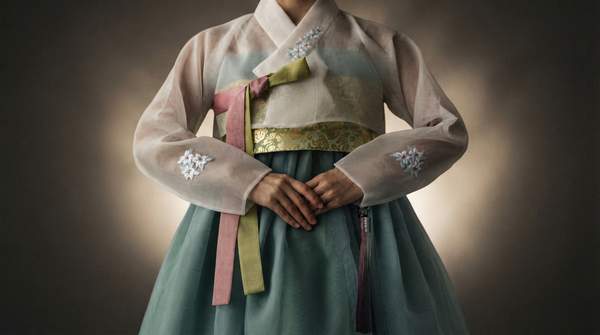
Think of hanbok as a sentence. Each part is a word with its own meaning. The silhouette is instantly recognizable: a swirling skirt in vibrant colors, a crisp jacket fitted neatly at the waist, and delicate ribbons fluttering in the breeze. That is the image of a garment that balances elegance with structure.
The underlying logic is simple and consistent: the upper garment is designed to be slim, while the lower garment is generously sized. For men, the basic set includes trousers, a jacket, a vest, and an overcoat, with belts and ankle bands to tighten the trousers, plus socks and shoes. For women, it includes underpants, underskirts, an outer skirt, undershirts, a jacket, an overcoat, socks, and shoes, accessorized with norigae pendant ornaments, rings, and chignon ornaments.
Construction is deceptively modest. The Ministry of Culture, Sports and Tourism notes that while hanbok's structure is very simple, using straight and flat patterns, the method of folding the margins and seams is specified for each piece. The craft lives in the finishing. Use the table below to identify the main parts and read the cultural language embedded in their design.
| Component | Traditional Design Feature | Cultural / Practical Meaning | Modern Adaptation |
|---|---|---|---|
| Hanbok (general structure) | Upper garment slim, lower garment generously sized; simple straight and flat patterns with specified fold and seam methods | Basic configuration maintained for about 5,000 years as Korea's unique ethnic clothing | Reimagined with modern cuts and lighter fabrics for daily wear |
| Jeogori (jacket) | Crisp jacket fitted neatly at the waist, with fluttering ribbons | Central to the balanced silhouette of elegance and structure | Shape reinterpreted by combining draping and flat patternmaking |
| Chima (skirt) | Swirling, generously sized skirt | Creates the flowing lower silhouette; fullness has evolved across periods | Silhouettes modified, referencing late Joseon forms |
| Men's set | Trousers, jacket, vest, overcoat; belts and ankle bands to tighten trousers | Complete formal configuration for men | Elements such as ankle bands reworked into contemporary pieces |
| Women's accessories | Norigae pendant ornaments, rings, chignon ornaments | Personal adornment completing the ensemble | Retained or restyled in modern interpretations |
| Colors | Blue, red, yellow, white, black | Represent the five elements in Korean philosophy—east/wood, south/fire, centre/earth, west/metal, north/water—symbolizing harmony, balance, and status | Symbolism remains rooted even as palettes modernize |
Color deserves a closer look. The five-element system maps each hue to a direction and a natural force: blue for the east and wood, red for the south and fire, yellow for the center and earth, white for the west and metal, and black for the north and water. Together they symbolize harmony, balance, and status. Particular combinations signaled different social standings and occasions, so a hanbok's palette could tell you who the wearer was before a word was spoken.
One caveat: these descriptions cover general forms. Specific silhouettes, skirt fullness, and color combinations varied by period, social status, and occasion. The five-color system is the documented symbolic core, not a fixed dress code.