Fashion's biggest stages are hosting models who break the traditional mold, but a single season of celebrated firsts does not equal systemic change. In October 2026, singer Ciara walked a major Paris runway visibly pregnant, and Nanabah Grace became the first Navajo woman to walk the Victoria's Secret Fashion Show. Those moments, alongside a reported wave of older models appearing across Spring/Summer 2027 runways, mark real movement in who gets cast. Yet expert commentary and industry data point in a more sobering direction: visibility at the top of the industry has not reliably translated into broader, sustained opportunity for marginalized models. Understanding both halves of that picture is the point of this article.
Three Moments That Redefined the Runway
Begin with the pregnancy moment, because it was unusually deliberate rather than incidental. During Paris Fashion Week, Ciara walked the runway for Junya Watanabe's Spring 2027 show while expecting her fifth child—a pregnancy she had publicly announced on September 6, 2026, with her husband, Russell Wilson. She did not make a single ceremonial appearance. She made three separate trips down the runway, each in a distinct look: a fitted purple crop top and leggings with hot pink accents, layered at different points with a beige trench coat, an oversized leather jacket, and a crystal-covered headpiece. The styling made the baby bump central to the presentation rather than something to be disguised.
Vogue's own coverage captured the deliberate repetition, sharing show footage with the caption that Ciara walks Watanabe's runway "not once, not twice, but three times—while expecting." That phrasing matters. A one-off appearance can be framed as a novelty; multiple looks integrated into a collection suggest a designer treating a pregnant body as part of the season's vision. Whatever the intent, the effect was to put pregnancy representation on one of fashion's most scrutinized runways, not at a fringe event but at the heart of Paris Fashion Week.
The second moment came weeks later and involved a different kind of boundary. Nanabah Grace—an IMG model and Victoria's Secret angel who attended Montezuma-Cortez High School in Colorado—made history as the first Navajo woman to walk the runway in what KOAT's report describes as the most-watched fashion show ever. Her frame of reference was explicitly cultural rather than purely professional. "I would love to represent my people in the best way that I can, and with Diné, it's to walk in beauty," Grace said. She also described the experience in the terms most models would recognize: "I think every model's dream is to walk the Victoria's Secret runway, truly. It's fun. It's playful."
Read those two quotes together and you see why the moment carries weight. Grace connected a mainstream global spectacle to Diné values, while also insisting on her place in modeling's conventional dream. The first-ness of the appearance is the headline—no Navajo woman had walked that runway before—but her own words frame representation as something richer than a statistic: an invitation for young people, as she put it, "to imagine yourself going beyond that little town and chasing your dreams."
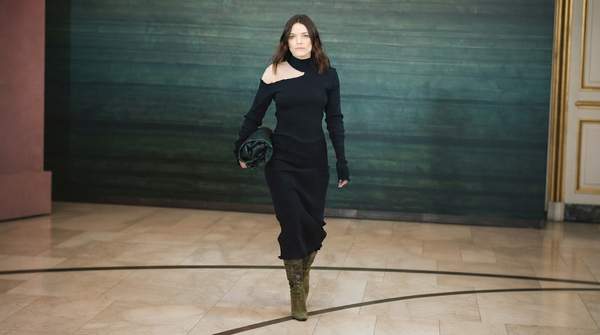
The third strand is less a single event than a pattern. As reported by The Globe and Mail, Spring/Summer 2027 runways have been featuring older models, including Toronto's Shani Feldman, who walked for Chanel and spoke with the paper about the experience. In an industry that has historically treated modeling careers as brief, the appearance of older models at the very top tier—Chanel's runway is among the most watched in Paris—is its own kind of challenge to the assumption that a runway model is by definition young.
Runway Revolution: Challenging Traditional Archetypes
Use the comparison below to see the three moments side by side. The table juxtaposes each instance of inclusivity—pregnancy, indigenous identity, and age—so you can isolate exactly which traditional archetype was challenged, by whom, and in what context, rather than lumping them together as one undifferentiated gesture of "diversity."
| Model/Event | Archetype Challenged | Designer/Show | Significance |
|---|---|---|---|
| Ciara walked the runway visibly pregnant, three times (October 2026) | The expectation that runway models are non-pregnant | Junya Watanabe Spring 2027 show, Paris Fashion Week | Pregnancy made central to a major Paris presentation while she expected her fifth child; Vogue highlighted the repeated walks |
| Nanabah Grace walked the show (October 2026) | Indigenous identity in a mainstream spectacle with no prior Navajo runway walker | Victoria's Secret Fashion Show | First Navajo woman to walk the runway in what KOAT calls the most-watched fashion show ever; she connected the moment to Diné values |
| Shani Feldman walked a marquee Paris show (Spring/Summer 2027 season) | Age—the assumption that runway models are young | Chanel | Part of a reported wave of older models on current runways, per The Globe and Mail |
Notice what distinguishes the rows. Ciara's moment rested on repetition and styling—the bump was styled into the collection, not worked around. Grace's moment rested on a historic first within a globally watched show, framed by her in explicitly cultural terms. Feldman's casting points to something potentially more durable: a trend reported across a season rather than a single celebrated appearance. One-off firsts and celebrity cameos generate the loudest coverage; a season-wide pattern, if it persists, is the harder signal to fake.
What the table cannot tell you—and what the next section addresses—is whether these moments change anything beyond the season that produced them. That question requires looking at the industry's casting record as a whole, and there the evidence turns sharply double-edged.
The Limits of Visibility
Celebrating a first is easy; measuring whether firsts become norms is harder. Diversity and inclusion consultant Tskenya-Sarah Frazer, quoted in a Vogue analysis by Maliha Shoaib, argues that visibility for women of colour often comes with conditions attached. "Women of colour are afforded some privilege as long as they stay in code with white supremacist and Eurocentric ideals of how they should behave and look, but those privileges are taken away the moment they move away from them," she said. The code, in her telling, extends to hair, speech, and behavior—and she has seen first-hand that slimmer and lighter-skinned women receive opportunities their larger and darker counterparts do not, pointing to studies showing a corresponding impact on pay equity.
Frazer's analysis reframes what a "diverse" casting sheet actually demonstrates. A model can be visibly present on a runway while still being required to conform to existing beauty norms in every other respect. Applied to the season's headlines, that suggests Ciara's, Grace's, and Feldman's appearances are genuine gains in visibility, but visibility under conditions is not the same as an expanded definition of who belongs on a runway.
The quantitative record reinforces the caution. Data reported by Refinery29, covering the spring/summer 2020 through spring/summer 2025 seasons, shows a decline in plus-size model representation across that period. That means the very years in which conversations about body inclusivity became mainstream in fashion commentary coincided with fewer plus-size models actually walking runways.
A parallel problem appears in a Fashion Studies account of disabled models' experiences, drawn from the reported experiences of one agent and one model named Richie. The account describes what researchers call a "paradox of visibility": a few highly visible disabled models can create a widespread impression of progress, while the everyday booking pipeline for disabled talent remains thin. The visible exception becomes evidence of change that has not actually occurred at scale.
Put the three threads together and the paradox has a clear shape. The same era producing Ciara's pregnancy moment, Grace's historic walk, and a wave of older models is also an era in which plus-size representation has declined for multiple consecutive seasons and disabled models report sparse day-to-day opportunity. High-profile firsts and celebrity casting generate outsized attention, and that attention can coexist comfortably with narrowing opportunity for models who lack a famous name or a headline-ready "first."
None of this diminishes the individual moments. Grace's walk mattered to her community and to everyone watching who had never seen themselves on that runway; Ciara's three looks reframed what a runway body can be; Feldman's Chanel booking challenged the industry's ageism. The critique is not of the models but of the inference—from these moments to "fashion has become inclusive"—that the broader data does not support.
Beyond the Runway: Monitoring True Inclusivity
Fashion industry stakeholders should prioritize systemic changes that move beyond tokenistic visibility to ensure genuine and sustained inclusivity across all aspects of modeling and design. For readers, that translates into a simple evaluation habit: judge a season not by its most shareable moment but by its casting numbers across every marginalized group, and judge progress not by firsts but by repetition.
The concrete standard to watch is to track the annual diversity reports for consistent increases in representation across all marginalized groups (plus-size, racialized, disabled, older models) and a decrease in the 'paradox of visibility' for these groups. Specific markers to look for in the seasons ahead: whether plus-size casting reverses the decline Refinery29 documented from spring/summer 2020 through spring/summer 2025; whether older models like Feldman appear across multiple major shows rather than a single headline casting; and whether disabled models report sustained bookings rather than isolated visibility. If those indicators move together, the October 2026 moments will have marked a turning point. If they do not, the walks will remain highlights—celebrated, historic, and still exceptional.